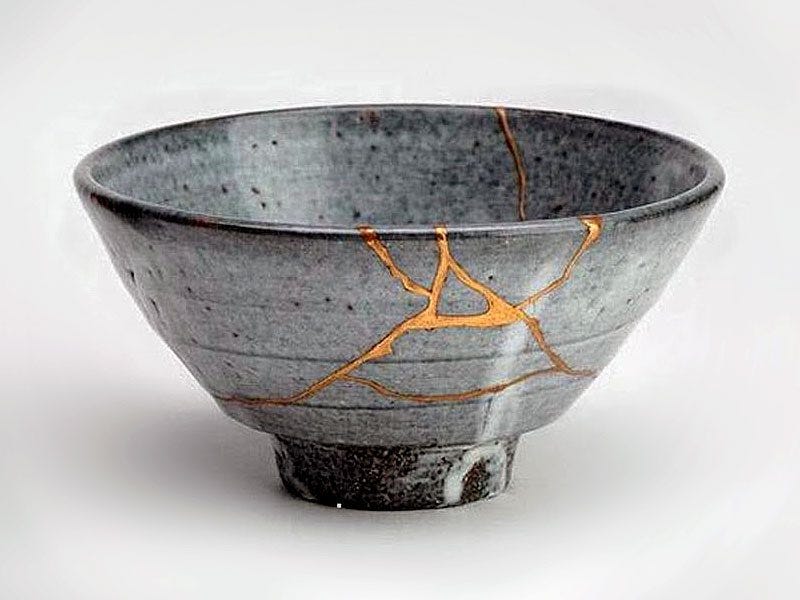
Kintsugi
What better to repair with than beauty?

Martin stopped by Ullerton’s office just before lunch. “Mr. Ullerton, I finished the Argentina plane crash case,” he called from the doorway. “51134-JH2 Green. All looks stable, report’s in.”
Ullerton looked up, surprised. Martin didn’t usually report in person, and it hadn’t been a remarkable case.
“You’re the best, Marty. Have you thought about accepting the supervisor’s position?”
“No thank you,” Martin said, as he had so many times.
Martin didn’t go to the lunch room. As he did most days, he went back to his desk. A few colleagues passed by him in the hallway, but they didn’t say anything. Martin wasn’t known for socializing at work; he was known for working harder and better than anyone, and not a lot else. Martin had been a time restoration artist at the Center for thirty-two years. No one had done it longer; he’d refused to retire. No one was more skilled at the job.
The kid across the hall, Singh, was okay. He’d likely never be great, but not every repair to the timeline required greatness. Martin could see him in there, lying back, his arms moving around, working on a simple case, one involving a bus crash. Only two fissures to fix, fairly easy ones. Martin had passed on it, sent it to Singh; it was a decent training case, not up to Martin’s skills, and in any case, Martin had a case to work on.
He closed the office door, sat back in the recliner, and plugged in. Gloves on, slipcovers on his feet, headset, and finally the jack into the right temple.
The reality device filled his senses. The real world faded away, and the chronoworld replaced it.
The world of time wasn’t dissimilar from the real one. Martin could see his office around him, and beyond it the rest of the gigantic Center headquarters. Beyond that, the rest of Illinois, mighty Chicago fifty kilometers to the north, and beyond Illinois, the world and all its mountains, trees, people, animals, oceans. It all shimmered, all of it, in space and in its fourth dimension, before now, stretching back. It was as if the objects and people were out of focus and yet sharper, saturated and yet also gray. To Martin, all appeared to be in the present, on the surface of it. At first.
In the virtual world Martin could rise up and move in every dimension. His mind had him drift now, towards the city. His perspective soared across the countryside. There were fissures in Aurora. Another was further away, almost in Wisconsin. Of course, there were fissures in the timeline throughout the world, but the case he was working on was local. Just a few small cracks in the timeline had to be fixed this afternoon; they were hairlines, tiny ones. Tomorrow was a bigger job, but when repairing the fabric of time, they had to do it in just the right order. It was Martin’s job, and Martin was the best at it.
He fixed the small fissures, leaving behind things that were quite lovely.
At five, the system shut down. No one worked late at the Center; five o’clock was quitting time, no matter what. It was better for security if everyone was out of the building, as the timeline was fragile. It had been ever since The Calamity, the experiment in time travel that went so horribly wrong. They kept the fabric of the universe from shattering, or so the powers-that-be claimed. Maybe it would all fall apart without the Center, maybe not. It had been a long time since the Calamity. In any event, the world carried on, and every now and then one noticed something prettier, more pleasant, more comely, and all knew it was the time artisans.
Martin got on the train back to the city, carrying only his lunch bag. He never ate the cafeteria food. He had a fussy stomach.
Martin walked home from the train station to his little house near Washington Park. He arrived home at ten minutes to six, as he always did. Martin and his wife, Angela, ate dinner at six thirty, then took the walk that, these days, was very hard for Angela, but she insisted they take it all the same. They watched their shows, and were asleep by ten.
#
The job was much more challenging the next day. Martin helped Singh with a job before lunch, and then he resumed his work on his case.
Case 44091-KJ7-White was an old one; the traumatic impact to the essence of time had happened twenty-seven years before. Some cases were older, but most weren’t. It could take years for the fractures to become apparent from a tragic occurrence, but most were flagged within five years.
The mighty quantum computers and the dark, hyperintelligent constructs contained in their circuits, the Great Minds, churned away in the great caverns hidden away in the remote safety of the Arctic archipelago. There they saw the fractures forming and reported the dangers, deciding which ruptures were dangerous and must be fixed. The singularity generators, equally safely left in the seismically dead Pilbara craton in remote Australia, allowed holes to be punched in the fabric of space, allowing access to the manipulation of time and matter itself, to fix the cracks in time found by the fathomless intelligences.
Martin swept along in the chronoworld. Today, finally, after years of working on and off on case 44091-KJ7-White, fixing the tiniest chips and nicks in time, he could repair the first of three major fractures. The world sped by as he seemed to soar over the flat plains and comely towns of Illinois.
Below him, the world shimmered. Martin could see the repairs made over the years, some by him, most by the other artisans. They could not have been more obvious. In real life they looked like nothing more than the beautiful and the pleasant. In the chronoworld, they glowed in warm, brilliant gold. There was no mistaking them. Some of the repairs had been made decades before; their glow was more muted, but they glowed still.
The cracks in time, of which Martin saw only a few here, were harder to see, though his long-trained eye spotted them. They were black at their heart, ringed with a fiery red. The ones he could see as his point of view flew by weren’t his to fix today. Someone else would get them eventually. Each case was to be worked only by the assigned time artisan.
In the virtual world, he flew to an abandoned lot in Calumet. An old warehouse, long ago burned and only mostly cleared away, remained evident in the form of cindered, forgotten debris. The angry scarlet glow haloed the site.
The case that caused this wound in time, one connected from a thousand others Martin had previously fixed, was a very minor one, of the sort that rarely caused detectable problems; one person killed by a drunk driver, twenty-seven years ago. Rarely did a tragedy involving one death attract the attention of the Center. Of course, the tragedy itself could not be fixed. None of them could; the beginning, the headwater, of the great fractures in time, was always natural, and so, unrepairable. The cracks left in their wake were what sometimes violated the true nature of the universe, breaking time. Some breaks were harmless; others were severe enough to need repair. They could be not just fixed, but improved upon. The murdered pedestrian could never be brought back. The results of repairing the cracks could be made beautiful.
Martin’s mind floated over the lot. He reached out, and began to work.
With his fingers, he began to mend the break. To Martin, it felt as if he was closing the break with his fingers, stitching, gluing, tying. On opposite sides of the world, the mighty quantum computers, eighty stories tall underground, churned through the quintillions of calculations sent to the mighty particle guns on the other side of the planet in the Australian desert. Those gigantic machines fired countless quanta of energy, arriving at countless points of time throughout the history of the universe, to this one place in a small town in the Midwest, a place of no importance on a cosmic scale but of central importance to a select few people on Earth. Martin could feel the distant vibration of all that incomprehensible power flowing through his avatar.
As this happened, the present changed. The burnt boards, cracked cinderblocks, and discarded sheets of metal vanished. They were replaced with grass, shrubs, a hillock. Martin did not entirely design what he was creating; it seemed to help design itself, as if emerging from a different reality. He guided it only in general, like a conductor with an orchestra he could trust. It worked, of course. It always did, at the hands of a master, and Martin was a great master.
For three hours, Martin worked. Physically the exertion was mild; mentally it was exhausting. Although his sense of time in the chronoworld wasn’t aligned with the real world, long experience told him it would almost be lunch when it was done.
The breach in time was forever healed, and now, in place of the blight, was a new park. A handsome stand of maple trees stood at the west end. A pond, already attracting fowl, was ringed with paths and lawns. The east end had a playground with swings, slides, a splash pad, and a small jungle gym for the little ones. Soon it would attract happy families who would see this new beauty. They would know the Center had fixed something here – not just that the blight was gone, but that the unease they had felt in their hearts around this place was gone. Children would play here, and dogs would chase their tennis balls, and families would bring their picnics and be in the company of those they loved. It was what the Center did. For whatever reason, another reason science could not entirely explain, beauty helped to mend the fractures. The artisans always covered the repair with beauty.
Martin disconnected from the system. Working through lunch was unwise; it could wear the artisan out. Before he had his lunch, brought as always in his modest lunchbag, Martin made sure to tell Ullerton he was going to work on the ferry disaster case that afternoon.
“Okay, Marty,” said Ullerton. “FYI, the auditors are coming this week. Apparently we’ve got more misrepairs, or something? I haven’t looked at the data yet. It’s likely a routine check. I hope.”
Misrepairs did happen, when an artisan might fix a minor fissure in time that was not part of an authorized case. A time artisan not paying close enough attention could make an error, or follow one hairline fracture too far into another. Only the repairs that the great computers said should be fixed, could be fixed. The manipulation of time and space could not be left to chance. A few incorrect patches were no catastrophe, but the auditors were perpetually on top of things to ensure the artisans were disciplined in their work.
Mistakes happened. Deliberate violation of the rules was unthinkable.
“Misrepairs do happen, Mr. Ullerton,” said Martin.
“Of course. But when you’re in there, you’ll keep an eye out, right?”
“Yes,” said Martin.
“Thanks, Marty. How’s Angela?”
“Oh, we’re all good, thanks,” said Martin, and he went back to his office.
#
After work, Martin walked to the train station. The Center’s enormous building was surrounded by nothing. It had been built in the countryside for security reasons, but also to discourage the petitioners. There were always a few anyway, people who wanted to ask the Center to fix things. Often the things they wanted fixed weren’t time fractures at all. Most often, they wanted someone brought back to life, but that was as impossible to do as it was to explain to a bereft human being why their beloved could not be brought back. No one knew why the dead could not be brought back, why the originating tragedy couldn’t be fixed, only the cracks. It just was.
Some of them held signs, or items connected to their loved ones, standing by the gates in silent hope. Martin walked past the people who wanted their prayers answered, his head down, knowing some prayers could never be answered.
Why human tragedy caused time to break, no one knew. Why some tragedies rent the fabric of time and most did not was a puzzle. Why some caused fractures that became noticeable and dangerous, and some caused tiny cracks that scarcely mattered, was equally mysterious. And why the dead could not be brought back to life, when other things could be brought into existence, no one could begin to explain. Science was trying to solve these riddles, but had been unsuccessful. The religious claimed to already have the answers but all disagreed with one another. These things were simply true, and the Center fixed them as best they could.
As Martin rode the train home, he did a crossword puzzle, as he always did. He arrived home at ten minutes to six. Martin and Angela ate dinner at six thirty, then took the walk that, these days, was very hard for Angela, but she insisted. They watched their shows, and were asleep by ten.
#
The following morning’s work took Martin to a place north of Chicago, just south of the Wisconsin border. The familiar, ugly red glow, a black hole of utter nothingness at its center, roiled in the centre of Deer Lake, an out-of-the-way pond that in real life would have seemed unremarkable but for the fact it was long dead, killed off with pollution. Such things were an odd thing now; most environmental disasters had long ago been cleaned up. No doubt, the authorities were puzzled as to why this one defied their efforts. It was plain to Martin, of course; a break in the universe was the cause. It was not an especially large or dangerous rupture, but it was the penultimate repair in this case. One fracture led to the next, and this was the one that let to the final blizzard of necessary repairs. It had to be fixed before the last, much trickier phase.
Martin worked quickly, his hands guiding the forces of time and space themselves. He knitted together the hole in time, and patched over the chaos and emptiness with life and beauty. The water was cleaned, made just so, the perfect sort of water meant to be there left behind by the mighty glaciers of the Pleistocene. The ground surrounding the lake sprung up with plants, reeds, grasses. Fish swam there again. Martin, smiling in the chronoworld as well as in his chair in his office, knew only hikers would see it. Perhaps people would come to fish there in time.
That afternoon, Martin worked another case. He was interrupted by an alert, sent in from the real world to his consciousness in the chronoworld, calling him out.
There was an impromptu meeting in the lecture hall. Several dozen confused time artisans and an equal number of support staff murmured to each other about what might be going on.
Ullerton, looking perturbed, stepped to the front. “Look, as most of you know, the auditors were gonna come in a few days, but now they’ve moved it up to the day after tomorrow, and they’ve sent me the numbers that say why. We are off in temporal compliance by one point three percent.”
A palpable frisson ran through the group. One point three was an extraordinarily high amount of timeline manipulation that could not be accounted for by the needs of their assigned cases. The mighty artificial minds could not be that inaccurate.
Ullerton held his hands out, almost pleading. “I’ve been running diagnostics all morning. I can’t find anything wrong in the system itself. Does anyone know what the hell’s going on out there?”
Nobody said a word.
Ullerton frowned, shook his head, and looked at the bad news on his tablet. “Fine,” he said, “maybe it’s some error a little deeper. But be CAREFUL, for Christ’s sake. You know how the auditors are.”
They all did. All were frightened of the auditors. They were brilliant at their jobs as well as being law enforcement officers. There were stories of artisans from decades ago sent to prison for life. Those stories might or might not be true.
“Back to work. Don’t fuck up,” said Ullerton.
As he was walking back to his office, Martin was intercepted by Ullerton. “Marty, everything okay in the chronoworld?”
“Yes,” said Martin.
“Are YOU okay? You look a bit off.”
Martin thought quickly. “Yes. I’m fine, sir, I’m just nervous about auditors being around.”
Ullerton furrowed his brow a little, then said “Me too. Alright, thanks, Marty.”
There wasn’t much time left before five to work the ferry disaster case, but Martin did what he could before they all left work, many of the artisans still talking to each other about what was going on.
Martin arrived home at ten minutes to six. He and Angela ate dinner at six thirty, then took their walk, slower than they used to, of course. Then they watched their shows and were in bed by ten, though Martin was awake a little longer.
#
The next day it was confirmed the auditors would be in the next day. Ullerton was in a panic, directing the administrative staff here and there, looking at five tablets at once. When he saw Martin he practically ran to him.
“Marty, you haven’t noticed anything? Have any ideas?”
“No,” said Martin.
Martin went to his office, not talking to anyone, and was ready to begin work precisely at nine, when the gateways to the chronoworld opened.
This, the final part of the case, was not one repair, but over a hundred.
The avatar-Martin rose up, past the sky, into space, the equal of ten thousand kilometers from Earth, looking down through cloudless skies. Below him, keyed into the case he was working on, scattered all over the world, he could see them; not one fissure in time but a hundred, no, two hundred, tiny chips in time. Not one was a threat to rupture the universe; any one could be fixed with a wave of his hand. But Martin’s job now, a notoriously difficult one, was not to fix the wounds in time where they were, but to move the breaks from their current location to one other place, and concentrate the salve of time there.
Like a hawk, he dove down on the first chip, a tiny blip of scarlet-ringed darkness, performing the complex movements needed to move and fix it. Then the next, then the next. In the chronoworld the only limitation on his movements was the speed of light itself, but Martin’s mind was of course only a human’s mind, and this was careful, precise work.
For hours his imaginary self bolted from Chicago to New York to Paris to Bucharest, then to Cairo, Gaborone, Cape Town and Delhi, and on around the world, huge cities and small and places in the woods, at each place carefully transferring the chip in the fabric of the universe itself and bringing it back to the gathering place, and then back out again, over and over.
He tired quickly. He was going faster than he ought, but he knew he had less time than he had hoped.
Fifty done. Seventy. Ninety. A hundred. A hundred and twenty. Years he had worked towards this. He was close to done.
And then the chronoworld suddenly, unexpectedly, began to fade.
Martin sat up in his office. Before he even took the headset off and unplugged, he knew it was over. He had not quite completed the task entirely, but he had been ninety percent done. It was good enough; yes, Martin thought, good enough.
That Ullerton was standing there, a tablet in his hand, was precisely what Martin expected. That he was alone was a bit unexpected.
“It was you,” Ullerton said. “I can’t believe it. You. On purpose.” He held up the tablet on which, Martin assumed, was the data proving he had found out what Martin was doing.
“Yes,” admitted Martin.
“You… you worked on a nonapproved case? You, of all people? Why?”
As Ullerton catching him was something he’d hoped to avoid, Martin hadn’t prepared a lie. He considered coming up with one, but decided it was pointless. “I thought this case was worth it…”
“Worth going to PRISON?” yelled Ullerton. He flinched and peeked out the window in the office door, out of reflex. The offices were soundproof anyway. “Spending the rest of your life in a cage? Are you insane?”
Martin shook his head.
Ullerton stared at him, then looked at the floor, silent. Then after some time, he looked up and finally said, “This is what you’re going to do. You’re going to stand up, go straight to the elevator, and get out of the building and go home. You’ll take a few sick days. Then you’ll go to your doctor and say you have stress and can’t work, and you’ll go through the administrative nonsense for long term leave. Then in a month you’ll quit. You’ll never come back. I’ll tell the auditors that I think the excess usage was all cross-case confusion.”
Martin started, “Mr. Ullerton…”
“Shut up, don’t speak anymore. It might work. But if they figure it out, I’m not going to protect you. This is all I can do for you. I have children, and they need me. I think you’re a good man, Marty. Just go.”
“Yes,” said Martin.
#
As Martin rode the train home, earlier than he usually did of course, he did a crossword puzzle. He arrived home at ten minutes to one.
Martin got inside the little house near Washington Park and took off his shoes. Usually, he would then walk into the kitchen, but today he went into the living room instead.
Angela sat on the sofa. On the walls of the living room, covering the walls, were paintings, more than a hundred paintings. They had not been there that morning. Now the newly arrived paintings adorned the room in such numbers that scarcely any of the walls underneath them could be seen. There were so many that parts of some of them were obscured behind furniture. Martin could see that they spilled out of the living room and into the hallway that led to the stairs, covering the walls as they climbed to the second floor.
Martin sat next to Angela and looked at the paintings. There were still lifes, landscapes, abstracts, and portraits. One portrait was obviously of Angela, flawlessly capturing the grace and kindness Martin knew so well. The paintings contained more than just the evidence of technical skill and craft. They revealed the heart of an artist who knew the wonder of the world around them. They were unspeakably stunning. A lifetime’s work of magnificent art surrounded Martin and Angela.
“Martin, they’re so beautiful,” Angela said. She had been crying, Martin could see. He took her hand.
“Yes,” said Martin, gazing at the artistry, the majesty, all around them.
“This is what she would have painted?”
“Yes,” said Martin.
These were what Caia would have painted, had her life not been stolen from her… or maybe, Martin thought, she did paint them, but in some other world.
For a few moments, Martin and Angela dreamt of Caia, their beautiful daughter, taken from them twenty-seven years ago by a drunk driver, just as she had been starting art school, their hearts torn asunder. They looked at the works around them, the calling, the lifetime of created beauty, that should have been, and now, somehow, miraculously, was.
“Thank you, dear,” whispered Angela.
“I’m sorry I couldn’t bring her back to you,” sobbed Martin, who, for the first time in twenty-seven years, wept.
“But you did, sweetheart,” said Angela. “You did.”